

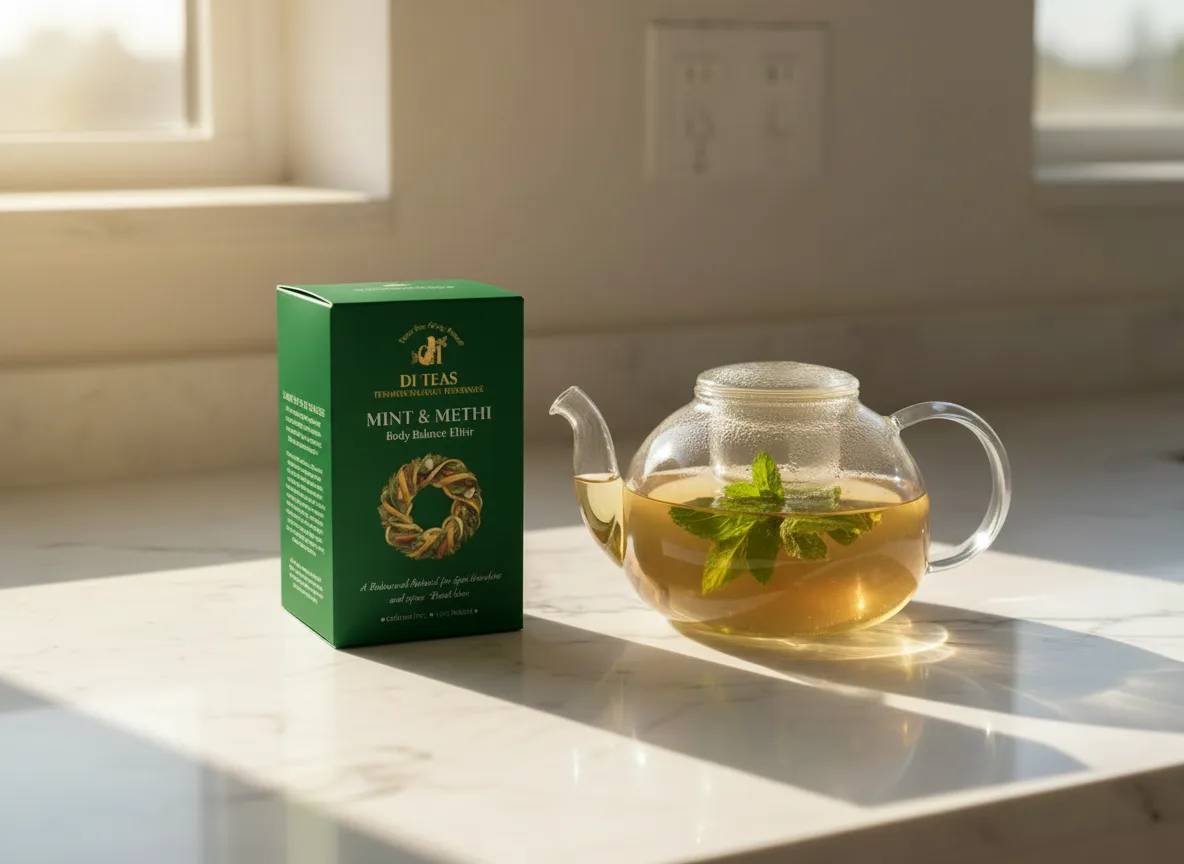
A refreshing ritual, inspired by moments of imbalance we all recognise
Modern routines often move faster than our bodies can comfortably follow.
Meals happen quickly, cravings appear unexpectedly, and digestion is sometimes treated as an afterthought rather than a foundation.
Across cultures, herbal infusions have long played a role in daily nourishment — often enjoyed after meals, during moments of heaviness, or when the body feels slightly out of step. Not through force, but through rhythm. A familiar cup that brings lightness, warmth, and steadiness.
Mint & Methi Body Balance Elixir was created in that spirit.
This journal shares the story, botanicals, and thoughtful approach behind the blend — not as a promise, but as an invitation.
This article is shared for general education and reflection. It is not medical advice.
Journey Towards Balance
The inspiration for this blend came from a moment that felt both ordinary and familiar.
A full day.
A busy schedule.
Meals taken quickly between commitments.
Not discomfort — but the subtle feeling of heaviness that sometimes follows when the pace of life moves faster than the body prefers.
There was nothing dramatic to correct.
Only the quiet awareness that the body was asking for something lighter.
Instead of reaching for rules or restriction, I turned to something simpler — herbs long associated with refreshment and digestive balance.
Mint for cool clarity.
Methi for grounding steadiness.
Ginger for gentle warmth.
Tulsi for balance.
Lemon peel for brightness.
Cinnamon, cardamom, and black pepper for depth and harmony.
The first cup felt clean and bright, with gentle warmth underneath.
There was no sudden shift to announce — only the feeling that the moment had softened, and that sometimes balance begins with something simple.
That moment became the inspiration for Mint & Methi Body Balance Elixir — not as a correction, not as a restriction, but as a daily ritual.
A refreshing cup created for those seeking steadiness in how they nourish themselves — and awareness in how they respond to cravings.
A thoughtful, evidence-informed approach
Being evidence-informed does not mean turning everyday rituals into clinical claims. It means approaching formulation with respect — for tradition, for research, and for individual experience.
When creating this blend, we looked at:
Traditional digestive herbal practices
Contemporary research literature
The role of aroma, warmth, and ritual
Mint & Methi Body Balance Elixir reflects this by focusing on refreshment, digestive comfort, and sensory balance rather than therapeutic claims.
The Botanicals Behind The Blend
Each ingredient in Mint & Methi Body Balance Elixir was chosen not only for tradition or study, but for how it contributes to the overall experience.
Mint (Mentha spp.)
Mint has been widely used across culinary traditions for its cooling flavour and digestive associations. It is commonly consumed after meals to create a sense of lightness and refreshment.
Scientific literature has explored mint preparations in relation to gastrointestinal comfort and digestive relaxation, particularly in the context of post-meal digestive ease.
Methi / Fenugreek (Trigonella foenum-graecum)
Fenugreek seeds have a long history of culinary and traditional use, particularly in South Asian and Mediterranean food practices. They are often associated with fullness and balanced eating patterns.
Modern studies have explored fenugreek in relation to satiety and appetite perception, including its influence on feelings of fullness following consumption.
Tulsi (Ocimum sanctum / tenuiflorum)
Often referred to as Holy Basil, Tulsi holds cultural and traditional significance in South Asian wellness practices. It has historically been consumed as an infusion associated with daily balance.
Scientific literature has explored Tulsi for antioxidant activity and broader wellness applications. It has been shown to cuts stress symptoms by 39%, easing emotional eating triggers like cortisol surges.
Ginger (Zingiber officinale)
Ginger has been valued across cultures as a warming botanical commonly included in digestive preparations. Traditionally, it has been used in blends consumed after meals.
Modern research has examined ginger in relation to digestive motility and gastrointestinal comfort, and showed reduced feelings of hunger with ginger consumption, suggest a potential role of ginger in weight management.
Cinnamon Bark (Cinnamomum verum)
Cinnamon contributes warmth and aromatic depth. Historically, it has been used in culinary and herbal traditions to enhance flavour complexity and digestive balance.
Scientific literature has explored cinnamon bark for its phytochemical profile and antioxidant activity. It is known to stabilize post-meal glucose to prevent crashes that fuel sugar urges.
Green Cardamom (Elettaria cardamomum)
Cardamom is widely used in traditional beverages for its aromatic lift and refreshing qualities. Its bright fragrance contributes to the polished and layered character of the blend.
Research has explored Cardamom’s cineole and terpinyl acetate promote diuresis to reduce water retention while easing gut spasms and bloating for smoother digestion and metabolic processes.
Black Pepper (Piper nigrum)
Black pepper has long been used as both a culinary spice and a supportive botanical in herbal preparations. Traditionally, it has been valued for its warming properties.
Modern studies have examined piperine, the primary active compound in black pepper, in relation to digestive activity and bioavailability. It is shown to block dietary fat absorption while enhancing other herbs’ bioavailability.
Lemon Peel (Citrus limon)
Lemon peel contributes brightness and aromatic clarity. Citrus peels have traditionally been used in infusions to create refreshing flavour profiles.
Scientific literature has explored citrus peel compounds in relation to antioxidant activity and aromatic characteristics. It has shown to repair gut barriers and boosts SCFAs for smoother digestion and fullness.
Refreshment, Digestion, and The Sensory Experience of Tea
Beyond individual botanicals, the experience of preparation matters.
Heating water.
Steeping botanicals.
Inhaling aroma.
Sipping slowly.
These small sensory signals can shape perception — influencing how fullness, satisfaction, and comfort are experienced.
Research in sensory science suggests that aroma and ritual can influence subjective experiences, independent of pharmacological effects.
For many, the act of preparation becomes a moment of reset.
A pause between meals.
A moment before cravings take hold.
A quiet return to awareness.
Mint & Methi Body Balance Elixir was designed to honour that moment.
A moment of refreshment.
A moment of balance.
A moment of intention.
And sometimes, that is where steady habits begin.
Shop Mint & Methi Body Balance Elixir Now
References
MINT
- Hu G, Yuan X, Zhang S, Wang R, Yang M, Wu C, Wu Z, Ke X. Research on choleretic effect of menthol, menthone, pluegone, isomenthone, and limonene in DanShu capsule. Int Immunopharmacol. 2015 Feb;24(2):191-197. doi: 10.1016/j.intimp.2014.12.001. Epub 2014 Dec 12. PMID: 25499726.
- Scott C. Hutchings, Katy M. Horner, Victoria A. Dible, John M.V. Grigor, Dolores O’Riordan. Modification of aftertaste with a menthol mouthwash reduces food wanting, liking, and ad libitum intake of potato crisps. Appetite, Volume 108,2017, Pages 57-67,
ISSN 0195-6663, https://doi.org/10.1016/j.appet.2016.09.022.
(https://www.sciencedirect.com/science/article/pii/S0195666316304706)
METHI (FENUGREEK)
- Khorshidian, Nasim, Mojtaba Yousefi Asli, Masoumeh Arab, Abolfazl Adeli Mirzaie, and Amir Mohammad Mortazavian. 2016. “Fenugreek: Potential Applications as a Functional Food and Nutraceutical.” Nutrition and Food Sciences Research 3 (1): 5–16. https://doi.org/10.18869/acadpub.nfsr.3.1.5.
- Kim J, Noh W, Kim A, Choi Y, Kim YS. The Effect of Fenugreek in Type 2 Diabetes and Prediabetes: A Systematic Review and Meta-Analysis of Randomized Controlled Trials. Int J Mol Sci. 2023 Sep 12;24(18):13999. doi: 10.3390/ijms241813999. PMID: 37762302; PMCID: PMC10531284.
TULSI
- Jamshidi N, Cohen MM. The Clinical Efficacy and Safety of Tulsi in Humans: A Systematic Review of the Literature. Evid Based Complement Alternat Med. 2017;2017:9217567. doi: 10.1155/2017/9217567. Epub 2017 Mar 16. PMID: 28400848; PMCID: PMC5376420.
GINGER
- Mansour MS, Ni YM, Roberts AL, Kelleman M, Roychoudhury A, St-Onge MP. Ginger consumption enhances the thermic effect of food and promotes feelings of satiety without affecting metabolic and hormonal parameters in overweight men: a pilot study. Metabolism. 2012 Oct;61(10):1347-52. doi: 10.1016/j.metabol.2012.03.016. Epub 2012 Apr 24. PMID: 22538118; PMCID: PMC3408800.
- Hu ML, Rayner CK, Wu KL, Chuah SK, Tai WC, Chou YP, Chiu YC, Chiu KW, Hu TH. Effect of ginger on gastric motility and symptoms of functional dyspepsia. World J Gastroenterol. 2011 Jan 7;17(1):105-10. doi: 10.3748/wjg.v17.i1.105. PMID: 21218090; PMCID: PMC3016669.
CINNAMON
- Anderson RA, Zhan Z, Luo R, Guo X, Guo Q, Zhou J, Kong J, Davis PA, Stoecker BJ. Cinnamon extract lowers glucose, insulin and cholesterol in people with elevated serum glucose. J Tradit Complement Med. 2015 Apr 18;6(4):332-336. doi: 10.1016/j.jtcme.2015.03.005. PMID: 27774415; PMCID: PMC5067830.
- Kizilaslan N, Erdem NZ. The Effect of Different Amounts of Cinnamon Consumption on Blood Glucose in Healthy Adult Individuals. Int J Food Sci. 2019 Mar 4;2019:4138534. doi: 10.1155/2019/4138534. PMID: 30949494; PMCID: PMC6425402.
CARDAMOM
- Gilani AH, Jabeen Q, Khan AU, Shah AJ. Gut modulatory, blood pressure lowering, diuretic and sedative activities of cardamom. J Ethnopharmacol. 2008 Feb 12;115(3):463-72. doi: 10.1016/j.jep.2007.10.015. Epub 2007 Oct 22. PMID: 18037596.
- Alam A, Rehman NU, Ansari MN, Palla AH. Effects of Essential Oils of Elettaria cardamomum Grown in India and Guatemala on Gram-Negative Bacteria and Gastrointestinal Disorders. Molecules. 2021 Apr 27;26(9):2546. doi: 10.3390/molecules26092546. PMID: 33925478; PMCID: PMC8123808.
BLACK PEPPER
- Shah SS, Shah GB, Singh SD, Gohil PV, Chauhan K, Shah KA, Chorawala M. Effect of piperine in the regulation of obesity-induced dyslipidemia in high-fat diet rats. Indian J Pharmacol. 2011 May;43(3):296-9. doi: 10.4103/0253-7613.81516. PMID: 21713094; PMCID: PMC3113382.
- Tripathi D, Gupta VK, Pandey P, Rajinikanth PS. Metabolic Insights into Drug Absorption: Unveiling Piperine’s Transformative Bioenhancing Potential. Pharm Res. 2025 Oct;42(10):1857-1891. doi: 10.1007/s11095-025-03920-5. Epub 2025 Oct 6. PMID: 41053306.
- Anshuly Tiwari, Kakasaheb R. Mahadik, Satish Y. Gabhe,
Piperine: A comprehensive review of methods of isolation, purification, and biological properties, Medicine in Drug Discovery, Volume 7, 2020, 100027, ISSN 2590-0986, https://doi.org/10.1016/j.medidd.2020.100027.
(https://www.sciencedirect.com/science/article/pii/S2590098620300142)
LEMON PEEL
- Tinh NTT, Sitolo GC, Yamamoto Y, Suzuki T. Citrus limon Peel Powder Reduces Intestinal Barrier Defects and Inflammation in a Colitic Murine Experimental Model. Foods. 2021 Jan 25;10(2):240. doi: 10.3390/foods10020240. PMID: 33503995; PMCID: PMC7912126.
- Rozza AL, Moraes Tde M, Kushima H, Tanimoto A, Marques MO, Bauab TM, Hiruma-Lima CA, Pellizzon CH. Gastroprotective mechanisms of Citrus lemon (Rutaceae) essential oil and its majority compounds limonene and β-pinene: involvement of heat-shock protein-70, vasoactive intestinal peptide, glutathione, sulfhydryl compounds, nitric oxide and prostaglandin E₂. Chem Biol Interact. 2011 Jan 15;189(1-2):82-9. doi: 10.1016/j.cbi.2010.09.031. Epub 2010 Oct 8. PMID: 20934418.