
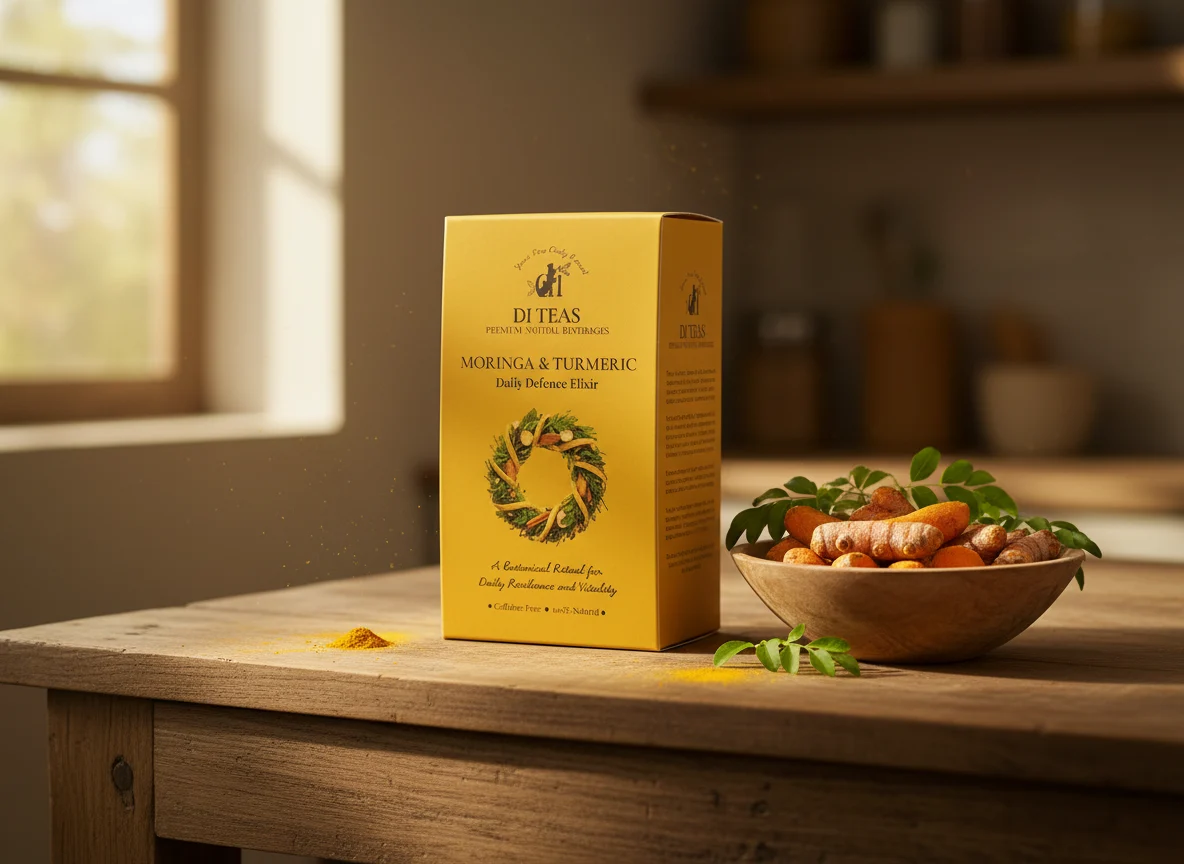
A daily infusion inspired by the body’s natural resilience
Modern life asks a lot of our bodies.
Long days, changing seasons, environmental stress, busy schedules, and the pressure to keep going can make us more aware of the importance of everyday wellbeing. We often think about immune health only when we feel under the weather — but nourishment and resilience are part of a much bigger picture.
Across cultures, botanicals have long been part of daily wellness rituals, enjoyed as warm infusions and valued for their nourishing, aromatic, and supportive qualities.
Moringa & Turmeric Daily Defence Elixir was created in that spirit.
This journal shares the story, botanicals, and thoughtful approach behind the blend — for education and reflection, not as medical advice.
Journey Towards Everyday Resilience
The inspiration for this blend began with a simple question:
What if supporting everyday resilience could be part of a daily ritual?
Rather than creating a blend around a single ingredient or a single moment of need, we wanted to bring together botanicals with different roles — nutritional, antioxidant, digestive, aromatic, and traditionally supportive.
The formulation began with Moringa and Turmeric.
Moringa provides a nutrient-rich botanical base, with naturally occurring vitamins, minerals, polyphenols, flavonoids, and other phytochemicals. Turmeric contributes curcumin, the compound at the centre of much of the scientific interest surrounding this golden spice.
Then came Black Pepper. Its piperine creates an important formulation synergy with curcumin, because piperine has been studied for its ability to increase curcumin’s bioavailability.
Ginger brings its naturally occurring gingerols and shogaols, along with a long history of use in digestive preparations.
Tulsi adds another layer, with research exploring its antioxidant, stress-related, and broader wellbeing properties.
Lemon peel contributes citrus flavonoids and naturally occurring compounds such as limonene, while clove brings eugenol and other phenolic compounds with antioxidant activity.
And Licorice Root contributes glycyrrhizin and other naturally occurring compounds, traditionally associated with soothing the digestive and respiratory tract, while providing natural sweetness without added sugar.
The result is a caffeine-free botanical infusion built around a simple idea:
Different botanicals. Different roles. One considered formulation.
A thoughtful, evidence-informed approach
Being evidence-informed does not mean turning an everyday beverage into a medical treatment.
It means looking at what is known about the botanicals, understanding where the evidence is strong and where it is still emerging, and considering how those ingredients work together within a food and beverage format.
When creating this blend, we looked at:
- Traditional botanical use
- Contemporary research literature
- The naturally occurring compounds within each ingredient
- Functional relationships between ingredients
- The sensory experience of the finished infusion
The result is a formulation centred around everyday nourishment and resilience, rather than therapeutic promises.
The Botanicals Behind The Blend
Each ingredient in Moringa & Turmeric Bio-Active Infusion was selected for a specific role within the formulation.
Moringa (Moringa oleifera)
Moringa has a long history of culinary and traditional use and is notable for its nutritional and phytochemical profile.
Research has identified a range of naturally occurring compounds in moringa, including flavonoids such as quercetin and phenolic acids such as chlorogenic acid. Moringa leaves are also recognised as a source of nutrients and antioxidant compounds.
In this blend, moringa forms the nutritional and botanical foundation.
Turmeric (Curcuma longa)
Turmeric is recognised for its distinctive golden colour and its naturally occurring curcuminoids, particularly curcumin.
Curcumin has been extensively studied for its antioxidant and anti-inflammatory activity. One of the challenges with curcumin, however, is its relatively low oral bioavailability — which makes formulation an important consideration.
Here, turmeric provides the functional golden core of the blend.
Black Pepper (Piper nigrum)
Black pepper is more than a warming spice in this formulation.
Its key compound, piperine, has been studied as a bioavailability enhancer for curcumin. Human studies have demonstrated that co-administration of piperine can increase curcumin exposure, although the magnitude varies depending on the formulation and dose.
This makes black pepper an important part of the blend’s central formulation principle:
Ginger (Zingiber officinale)
Ginger has been used across cultures as both a culinary spice and a traditional digestive botanical.
Its characteristic compounds include gingerols and shogaols, and clinical research has examined ginger in relation to gastrointestinal symptoms, nausea, gastric motility, and digestive comfort.
In the formulation, ginger contributes warming digestive character while complementing the deeper notes of turmeric and black pepper.
Tulsi / Holy Basil (Ocimum tenuiflorum)
Tulsi has deep cultural significance in South Asian wellness traditions and has been used traditionally as an everyday botanical infusion.
A systematic review of human studies found research exploring Tulsi in areas including stress, metabolic health, cardiovascular health, and immunity, while also noting the need for further research to clarify mechanisms, doses, and appropriate preparations.
In this blend, Tulsi contributes to the botanical resilience story, while its peppery and aromatic character balances the earthier ingredients.
Lemon Peel (Citrus limon)
Lemon peel is much more than a source of citrus aroma.
Citrus peels contain naturally occurring flavonoids and phenolic compounds, as well as essential oils rich in compounds such as limonene. Research has examined citrus peel for its antioxidant potential and phytochemical composition.
In this formulation, lemon peel contributes antioxidant-rich citrus compounds and aromatic brightness, helping balance the deeper botanical notes.
Clove (Syzygium aromaticum)
Clove is one of the richest culinary sources of the phenolic compound eugenol.
Research has explored eugenol and clove for antioxidant and antimicrobial activity, with clove’s high phenolic content contributing substantially to its antioxidant potential. Much of this evidence is laboratory or experimental rather than evidence of a clinical effect from drinking clove tea.
In the blend, clove provides eugenol-rich botanical depth alongside its warming aromatic character.
Licorice Root (Glycyrrhiza glabra)
Licorice root has a long history of traditional use, particularly in digestive and respiratory preparations.
Its characteristic sweetness comes largely from glycyrrhizin, alongside other naturally occurring compounds that have been studied for their biological activity.
In this formulation, licorice has a dual role: it contributes naturally occurring botanical compounds while also providing sweetness that rounds out the stronger earthy and spicy notes.
Because glycyrrhizin can have significant effects at high or prolonged intakes, licorice is an ingredient where responsible formulation and appropriate consumption matter.
The Synergy Behind The Blend
The formulation is not simply a list of eight botanicals.
The interesting part is how their roles intersect.
Turmeric + Black Pepper — Bioavailability Synergy
Turmeric provides curcumin.
Black pepper provides piperine.
Curcumin’s relatively low bioavailability is one of the challenges associated with consuming it orally. Piperine has been studied as one way of increasing curcumin exposure, making this pairing one of the most deliberate relationships in the formulation.
Moringa + Tulsi — The Botanical Foundation
Moringa contributes a broad phytochemical and nutrient profile, including naturally occurring polyphenols and flavonoids.
Tulsi brings its own phytochemicals and a body of traditional use alongside emerging human research.
Together, they create the botanical foundation of the blend.
Ginger + Turmeric — Complementary Warmth
Both ginger and turmeric contain bioactive compounds that have been extensively studied for antioxidant and inflammatory pathways.
Ginger also has a substantial body of research examining gastrointestinal comfort.
Together, they give the blend its characteristic warmth while contributing complementary botanical functionality.
Lemon Peel + Clove — Antioxidant Compounds
Lemon peel contributes flavonoids and citrus compounds such as limonene, while clove is particularly rich in phenolic compounds including eugenol.
Their antioxidant profiles add another layer to the formulation.
Licorice — The Harmonising Botanical
Licorice brings glycyrrhizin and other naturally occurring compounds, while its characteristic sweetness helps balance the stronger botanical notes.
This allows the formulation to remain functional without becoming overly harsh or difficult to enjoy.
The result is a blend where each botanical has a role — and where the formulation is designed around relationships between ingredients, rather than isolated claims.
Shop Moringa & Turmeric Daily Defense Elixir Now
References
MORINGA
- Bhattacharya A, Tiwari P, Sahu PK, Kumar S. A Review of the Phytochemical and Pharmacological Characteristics of Moringa oleifera. J Pharm Bioallied Sci. 2018 Oct-Dec;10(4):181-191. doi: 10.4103/JPBS.JPBS_126_18. PMID: 30568375; PMCID: PMC6266645.
- Saini RK, Sivanesan I, Keum YS. Phytochemicals of Moringa oleifera: a review of their nutritional, therapeutic and industrial significance. 3 Biotech. 2016 Dec;6(2):203. doi: 10.1007/s13205-016-0526-3. Epub 2016 Sep 22. PMID: 28330275; PMCID: PMC5033775.
TURMERIC / CURCUMIN
- Sohn SI, Priya A, Balasubramaniam B, Muthuramalingam P, Sivasankar C, Selvaraj A, Valliammai A, Jothi R, Pandian S. Biomedical Applications and Bioavailability of Curcumin-An Updated Overview. Pharmaceutics. 2021 Dec 7;13(12):2102. doi: 10.3390/pharmaceutics13122102. PMID: 34959384; PMCID: PMC8703330.
- Garg AX, Moist L, Pannu N, Tobe S, Walsh M, Weir M; Curcumin AAA AKI Investigators. Bioavailability of oral curcumin. CMAJ. 2019 Apr 15;191(15):E428. doi: 10.1503/cmaj.71719. PMID: 30988047; PMCID: PMC6464885.
BLACK PEPPER / PIPERINE
- Tabanelli R, Brogi S, Calderone V. Improving Curcumin Bioavailability: Current Strategies and Future Perspectives. Pharmaceutics. 2021 Oct 17;13(10):1715. doi: 10.3390/pharmaceutics13101715. PMID: 34684008; PMCID: PMC8540263.
GINGER
- Anh NH, Kim SJ, Long NP, Min JE, Yoon YC, Lee EG, Kim M, Kim TJ, Yang YY, Son EY, Yoon SJ, Diem NC, Kim HM, Kwon SW. Ginger on Human Health: A Comprehensive Systematic Review of 109 Randomized Controlled Trials. Nutrients. 2020 Jan 6;12(1):157. doi: 10.3390/nu12010157. PMID: 31935866; PMCID: PMC7019938.
TULSI / HOLY BASIL
- Jamshidi N, Cohen MM. The Clinical Efficacy and Safety of Tulsi in Humans: A Systematic Review of the Literature. Evid Based Complement Alternat Med. 2017;2017:9217567. doi: 10.1155/2017/9217567. Epub 2017 Mar 16. PMID: 28400848; PMCID: PMC5376420.
LEMON PEEL
- Munir H, Yaqoob S, Awan KA, Imtiaz A, Naveed H, Ahmad N, Naeem M, Sultan W, Ma Y. Unveiling the Chemistry of Citrus Peel: Insights into Nutraceutical Potential and Therapeutic Applications. Foods. 2024 May 27;13(11):1681. doi: 10.3390/foods13111681. PMID: 38890908; PMCID: PMC11172398.
- Balwinder Singh, Jatinder Pal Singh, Amritpal Kaur, Narpinder Singh, Phenolic composition, antioxidant potential and health benefits of citrus peel, Food Research International, Volume 132, 2020, 109114, ISSN 0963-9969, https://doi.org/10.1016/j.foodres.2020.109114.
CLOVE
- Cortés-Rojas DF, de Souza CR, Oliveira WP. Clove (Syzygium aromaticum): a precious spice. Asian Pac J Trop Biomed. 2014 Feb;4(2):90-6. doi: 10.1016/S2221-1691(14)60215-X. PMID: 25182278; PMCID: PMC3819475.
- Ulanowska M, Olas B. Biological Properties and Prospects for the Application of Eugenol-A Review. Int J Mol Sci. 2021 Apr 1;22(7):3671. doi: 10.3390/ijms22073671. PMID: 33916044; PMCID: PMC8036490.
LICORICE ROOT
- Wahab S, Annadurai S, Abullais SS, Das G, Ahmad W, Ahmad MF, Kandasamy G, Vasudevan R, Ali MS, Amir M. Glycyrrhiza glabra (Licorice): A Comprehensive Review on Its Phytochemistry, Biological Activities, Clinical Evidence and Toxicology. Plants (Basel). 2021 Dec 14;10(12):2751. doi: 10.3390/plants10122751. PMID: 34961221; PMCID: PMC8703329.
- Tibenda JJ, Du Y, Huang S, Chen G, Ning N, Liu W, Ye M, Nan Y, Yuan L. Pharmacological Mechanisms and Adjuvant Properties of Licorice Glycyrrhiza in Treating Gastric Cancer. Molecules. 2023 Oct 7;28(19):6966. doi: 10.3390/molecules28196966. PMID: 37836809; PMCID: PMC10574419.